Free shipping on every order · 90-day guarantee · Molded in Orange, California
The Game Night Cup Holder.com

Finally, somewhere to put your drink that isn't the carpet.

4.9 from 119 Steadi reviews

A flexible-finned base that holds your drink steady wherever tonight's game actually leaves it — the tray, the couch arm, the rug beside your chair. No dedicated gaming table required.

Get yours before next session — from $14.95

Free shipping · 30 real sessions to prove it · molded in Orange, California — not more shelf-of-shame junk.

Will tonight's drink fit? A sticky note off the score pad answers it — the test is below ↓

Prefer the maker's own store? steadilabs.com →

Left to right: the wide, low base empty, then holding a cup, a can, and a large tumbler.
One base, whatever's in play. Empty, then a rocks glass, a can, and the 40 oz tumbler that gets someone through the whole session — the same grip whether it's standing on the table or exiled to the floor.

How it goes

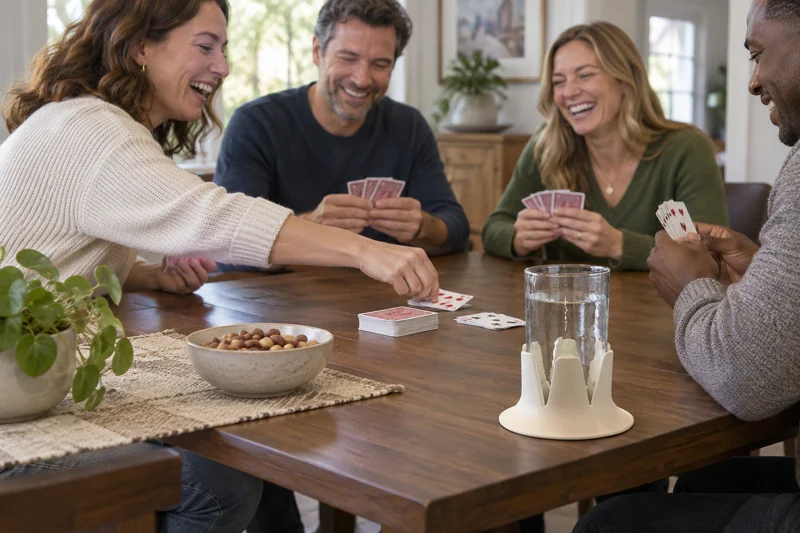
Every game night exiles the drink somewhere — and every somewhere is worse than the table.

A table hog of a game claims every flat inch before the first round even starts — board, tableau, discard pile, the sprues left over from tonight's punching. Whatever you're drinking doesn't get a seat, so it goes looking for one, and every spot left standing is soft, uneven, or already moving.

The table that already said no.

Board, tableau, discard pile, dice tray — a game in full swing claims every flat inch, and the house rule at plenty of tables is simply no drinks near the components. The glass doesn't get a seat, so it goes looking for one.

The carpet beside your chair.

This is where the banished drink actually lands — forum posters describe parking bottles on the rug next to their seat all night. It's below eye level once you're sitting down, invisible from above, and sitting exactly where a foot lands when somebody stands to refill or take a turn.

The couch arm, if you drew overflow seating.

Bigger groups spill onto the couch, and a couch arm is rounded, padded, and gives a can nothing level to rest against. Cushion foam does the rest — a flat-bottomed glass tips the moment somebody shifts their weight nearby.

The folding card table itself.

A standard table runs 34 by 34 inches, which leaves four seated players about 5 or 6 inches of table beyond the game — and that sliver sits on thin, flexing legs. A bumped knee or a leaned elbow jolts the whole surface, drink included.

The TV tray, the hobby's own fix.

The standard advice is a folding side table for every drink, and it's the recommended solution that fails the same way the problem did — reviewers report trays wobbling under a full glass and tipping outright on carpet, and it's one more skinny-legged thing to remember is there when somebody stands up.

None of it is a crisis. It's a decision the whole table makes without discussing it — where the drink goes once the game has claimed everything else — and every option left on the list is soft, uneven, or already moving.

Sound familiar

The nights every regular group already recognizes.

7:45 pm, mid-teach

Board, decks, and a stack of meeples get sorted onto the table before anyone's really settled in, and by the time the teach wraps, the whole table is full — everyone's holding a fresh drink with nowhere flat to set it. Most of them end up on the floor before the first turn.

Your turn, reaching

You lean across to place a piece on the far side of the board, sleeve passing directly over the one can somebody risked keeping on the table edge.

The big roll

Dice thrown with a little theater skip off the tray lip and scatter across whatever's in range — the same instinct that got the dice tower invented in the first place.

Hour three, the sprawl

A tile-layer like Carcassonne has grown past where the board started, annexing the last strip of table a can was standing on since setup.

The win, or the refill

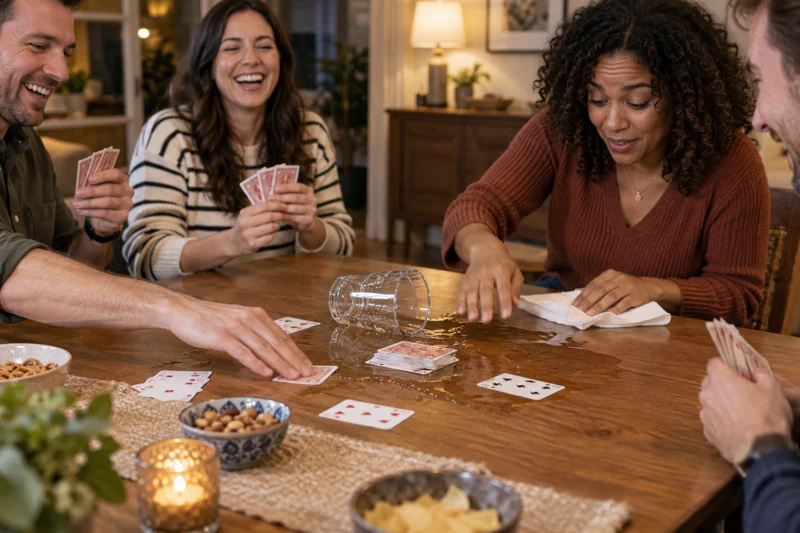
Somebody stands up fast — for the win, or just for another drink — the card table jolts on its folding legs, and their foot finds the glass that's been parked on the rug beside the chair since round one.

The story every regular group already knows

A first-edition HeroQuest doused by a full beer, renamed 'Beerquest' by its own owner, and cards ruined in the years before anyone thought to sleeve them — the hobby's two founding spill stories, retold whenever a new player reaches for a drink near somebody's shelf.

The paper test

The whole fit test lives in the game box's spare sticky notes.

your cup's base
lands in here

A square sticky note: 3 inches, exactly — pulled from the score pad, same as the ceiling of what fits.

01
Grab a sticky note.

The classic square is exactly 3 inches on a side. That's a fact about sticky notes — and it happens to be the exact ceiling of what fits.

02
Stand tonight's drink on it before it goes anywhere near the board.

Do it at the score pad, not the play area. Look at the bottom, not the rim — pint glasses flare and tumblers taper, and the base is the only measurement that counts.

03
Read the verdict.

Base sits inside the square? It fits. Hangs over the edges? Too wide. A little puck lost in the middle — under 2 inches? Too narrow.

No ruler, no spec sheet, no app open next to the rulebook — one sticky note off the score pad, one glance, with whatever's actually in your hand tonight.

What fits

The bottom inch decides what stays in play.

One line decides every verdict below: a container base 2 to 3 inches across settles in.

  • Standard 12 oz can fits
  • 16 oz tallboy fits
  • Beer bottle fits
  • Pint glass fits
  • Stemmed wine glass fits
  • Rocks glass fits
  • Solo cup fits
  • 40 oz Stanley-style tumbler fits
  • Coffee mug, handled handle in the way

There's a floor as well as a ceiling — under 2 inches the base sits too loose. The handled mug is the honest exception: the base fits, but the handle lands exactly where a fin needs to grip.

The full fit database — Stanley, Red Bull, Yeti, and 30 more, with sourced base measurements →

The simple physics

Built for the surface the game left you.

The base spreads across whatever's underneath it.

Carpet pile, a couch cushion, a card table that's mostly clutter — a narrow glass balances on a sliver of any of it and leans. The wide, low base lays flat across the surface instead, low and steady rather than perched.

The fins grip the bottom inch.

Flexible fins hold the drink from the sides, not by balance, so a nearly empty can grips the same as a full one — useful on a night where nobody's topping off the same glass twice.

It settles back.

A foot brushes the tray, an elbow lands mid-teach, the couch shifts under a new arrival — the wide base keeps its weight low, so it rocks instead of letting the bump turn into a spill, and brings the drink back level.

Nothing clips to a table, a tray, or a chair. No rail, no clamp on a table edge, no gaming-table vault sized for a seat that isn't yours. It sits directly on whatever surface the game left you — floor, cushion, tray lip — and packs flat in the same bag as the dice for next week's game night.

Where the game leaves you

The game gets first pick of every flat surface in the room. The drink gets whatever's left.

Nobody's being careless. Once the board claims the table, every surface still open is soft, uneven, or already moving — exactly the ground this base was built for.

Carpet or rug beside the chair

Soft, uneven pile that tilts anything with a flat bottom, and below your sightline the moment you're seated. A wide, low base settles into the pile instead of teetering on it.

The couch arm and cushions

Rounded and padded where extra players and between-turn loungers end up. Cushion foam tips a flat-bottomed can the instant weight shifts nearby — the fins hold the drink from the sides instead of asking the foam for footing.

The folding card table

Thin tabletop over skinny steel legs — it flexes and bounces with every shuffle or dice throw, and the little table space left beyond the game moves right along with it. A wide base rides the wobble instead of sliding on it.

The TV tray

Light and narrow-legged, and exactly the surface reviewers describe tipping under a full glass. A stable base on an unstable tray still keeps the drink upright when the tray itself sways.

The coffee table, already full

Snack bowls, the game box, a spread of punched cardboard, and now every drink the big table evicted — reaching over the clutter for a glass is exactly how bowls and drinks collide. A drink that settles on its own is one less thing to reach for.

Why drinks tip at game night — and why the carpet is where they actually land — the full story →

The competition, honestly

What the table's already tried, and where each one stops.

A folding TV trayThe Game Night Cup Holder
Where it sits once the table's fullNeeds its own spot on the floorSits on the tray, the cushion, or the carpet itself
Under a full glass on carpetReported to wobble and tip when loadedWide base grips the pile, resists tipping
When somebody stands up for the winEasy to forget it's there, gets knocked overSits low, holds steady when it's bumped
Holding more than the drinkFull tray — snacks, phone, the scorepad tooJust the drink
One more stand in the roomA stand per player, its own footprintNo stand — uses a surface that's already there
Between game nightsFolds, but stores as its own piece of furniturePacks flat, tucks in with the dice
CostAnother piece of furniture to buyOne small piece, nothing to assemble
Coasters, the hobby's default answer

A coaster protects the wood under the drink, not the game beside it — it does nothing when a sleeve catches the glass, and on a flexing card table it slides right along with everything else.

TV trays and folding side tables

The community's own recommended fix — and reviewers report it wobbles when loaded, tips outright on carpet, and gets forgotten and knocked over mid-game. It also means one more piece of furniture per player in a room already full of chairs.

Clamp-on table-edge cup holders

Reviewers describe openings too small for a standard can or bottle, weak spring tension, and clamps that slip off a thick edge under anything heavier than about 20 oz — and a card table's thin, flexing rim is close to the worst case for a clamp to bite.

Purpose-built gaming tables with rails and recessed vaults

The real fix the hobby invented, and it runs four figures and a delivery truck before a single drink is holstered — and even owners report groove-hung holders tilt enough that smooth cans slide right off when the table gets bumped.

From the reviews

What buyers say.

Recent reviews of the Steadi, from every room and rig it lives in.

★★★★★

I have a tendency to spill my drinks and have two cats. This is one of the best things I’ve ever impulse bought. It works. It actually works. It’s a heavy, wide enough base that it is actually stable. My “spot” in the living room is near a somewhat-cushioned fabric ottoman, which is where I usually put my drinks. It’s

Dixie · 2026-08-30
★★★★★

I love mine. I just wish the price was more appropriate. $15 seems a lot for a small plastic item. Reduce it to $9.99 and free shipping and I'll buy a few more!

Carolyn G. · 2026-08-27
★★★★★

Excellent!

Brian S. · 2026-08-27
★★★★★

Thank you for your service!

Brian S. · 2026-08-27
★★★★★

It’s great love it

gilbert a. · 2026-08-24
★★★★★

I never knock over my water at night anymore!

Customer · 2026-08-21

Read all 119 reviews →

All 119 reviews are for the drink base itself, collected across every place people use it.

Why more than one

Two identical pint glasses. One question nobody wants to stop the game for.

A host running a matching set of glasses for the table ends up with several that look exactly alike by round two, and nobody wants to pause the game to sort out whose is whose. It's a small thing until a full glass lands in the wrong spot and the argument outlasts the round.

Build your set

Give everyone their own.

Pick a pack, then give each one a color — so nobody has to ask which drink is theirs.

Fair questions

You're probably thinking…

“Is this just another 'solves my problem' gadget that ends up on the shelf of shame like the last three?”

No crowdfunding hype, no countdown, no stretch goals — one piece of material molded in small runs in Orange, California, with 30 real sessions to prove it before it's stuck on a shelf either way.

“Will it actually stop something from tipping, or is 'resists tipping' just marketing-speak for spill-proof with better lawyers?”

The site says what it doesn't do, too — handled mugs don't fit, it's not a sealed cup, and an out-of-print or particularly valuable game is still worth keeping the house rule for. It resists tipping and settles back down when it's bumped; that's the claim, not spill-proof or guaranteed.

“I already tried a TV tray for this and it wobbled loaded and tipped outright on the carpet anyway.”

That's the named failure mode: light, narrow-legged, and easy to forget until someone standing up knocks it over. This has no legs to wobble — it sits low and grips the surface itself, tray, carpet, or table, and settles back down when it's bumped.

“Does this mean I can finally drop the 'no drinks near the game' rule, or is that wishful thinking?”

It's framed honestly: it makes the rule easier to relax, not obsolete. For an out-of-print or particularly valuable game, keeping the rule is still a fair call — that's restraint, not a sales pitch.

“Will my actual pint glass or 40 oz Stanley fit, or is 'fits everything' just the ad talking?”

Check the base, not the rim, with a sticky note off the score pad — about 2 to 3 inches settles in, and the 40 oz Stanley fits. Nothing wider than that range gets promised, because it doesn't hold.

Good to know

Asked mid-teach, answered here.

Does it actually work on carpet, or just on the table?

Carpet is closer to home turf than a hard table is. The wide, low base spreads across the pile instead of tipping on it, and lets the drink settle back down when a foot brushes it or somebody shifts nearby.

My group ends up on the couch for overflow seating. Does it work there?

Yes — cushions and couch arms are soft and uneven the same way carpet is, and that's the terrain this base handles. It grips the drink from the sides with the fins instead of relying on the cushion for footing underneath.

Will it survive a sleeve reaching across for a card mid-teach?

That's close to the exact motion it's built for. It resists tipping and settles back down when it's bumped — a sleeve during the teach, a jolt from someone standing up, a die that skips off the tray. It's not a sealed cup, so on a heavier-pouring night a lidded tumbler adds a second layer.

Will my pint glass or tumbler fit?

Check the base, not the rim. A container base 2 to 3 inches across settles in — the 40 oz Stanley does. Handled mugs don't; the handle lands right where a fin needs to grip.

Does it need a table at all?

No. No rail, no vault, no fixed attachment point sized for a dedicated gaming table. It sits on whatever surface tonight's game left you — dining table, card table, tray, cushion, or floor.

We run a 'no drinks near the game' house rule. Does this change that?

It's exactly the kind of thing that makes the rule easier to relax — the drink stays where it's set instead of becoming something the host has to police all night. For an out-of-print or particularly valuable game, keeping the rule is still a fair call.

Does it leave a ring on the tray or the box lid?

The drink stands in the base, so a cold can's condensation lands there instead of on the wood, the tray, or the cardboard underneath — rings can start on bare wood in as little as 5 to 10 minutes, and this keeps the drink off it entirely. The base itself rinses clean in the sink.

Six players, six different drinks — do I need more than one?

One per drink in play, same as any cup holder. It doesn't care what's in the glass, only what shape the bottom is, so beer, wine, and seltzer all sit in the same base.

How do I clean it after a sticky game night?

Rinse it, wipe it down, or put it in the dishwasher. It's one piece of flexible material with nothing to take apart — unlike the components you're trying to keep dry.

Who makes it, and where do I buy one?

It's called the Steadi — molded in small runs in Orange, California, by Steadi Labs, veteran-founded and patent pending. Every order ships free from steadilabs.com, with 90 days to send it back if it's not for you.

All 19 questions, answered →

Ninety days at the table.

Bring it to the table for a month. If it doesn't do what this page says — through the teach, the big rolls, the late-game sprawl — email hello@steadilabs.com and it gets made right. No forms, no fight.

Veteran-founded · Patent pending · Made in Orange, California

Behind it

Molded closer than your FLGS.

The maker is Steadi Labs, a small veteran-founded company in Orange, California. It's injection molded in small runs, and nothing about it travels far — the mold, the material, and the color runs all sit within about three and a half miles of the shop, closer than most people's FLGS. The people who make it read hello@steadilabs.com themselves — same crew that packs the box, not a call center standing between you and them.

Give the drink somewhere better than the rug.

Wherever tonight's game pushes the drink — floor, couch arm, or table edge — it stays upright, and the only thing that ends up on the cards is how the game goes.

Give it a seat — ships free

Checkout is on steadilabs.com — Steadi Labs is the company that makes it.